


AV Over IP Or HDBaseT For Conference Room?
Nov 06, 2024
Leave a message
AV over IP : Super flexibility and scalability
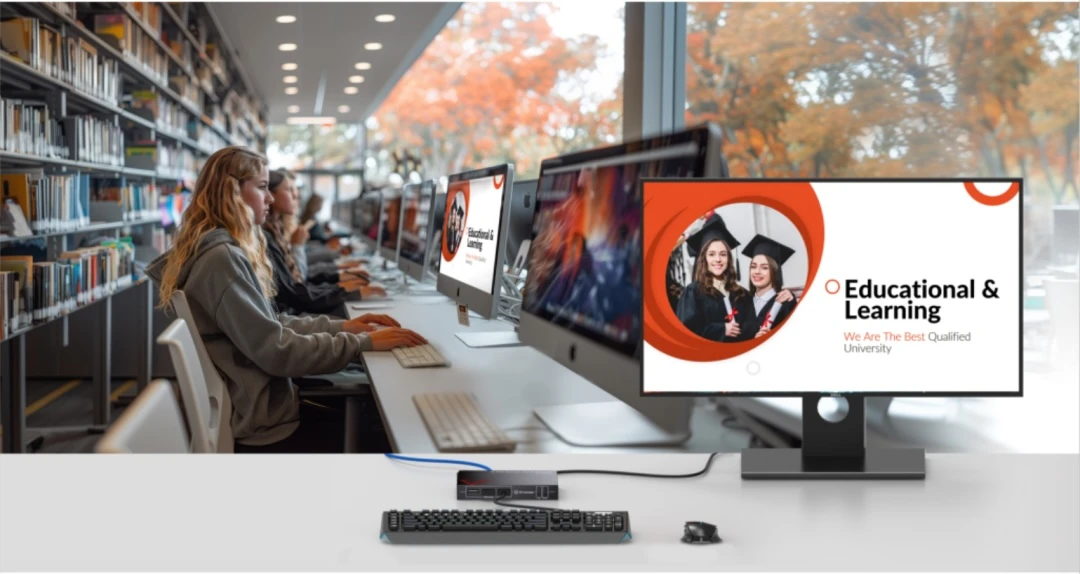
AV over IP refers to a technology that transmits video, audio, and related signals over standard Ethernet network infrastructure. Its components include an encoder, which converts A/V content into an IP format that can be transmitted over the network; a decoder, which converts the IP-format A/V content back to A/V format; and a network switch, which handles routing between the two.

Typically, adding encoders and decoders to an existing network can leverage the existing infrastructure without incurring additional equipment investment costs. However, requirements for bitrate, latency, and security, along with special network configurations to support these needs, usually mean that AV over IP needs to be handled on its own physical or virtual network. In terms of applications, AV over IP is ideal for projects that require high flexibility of input and output, scalability, and long transmission distances.
HDBaseT Technology : The only uncompressed video transmission TECH.

HDBaseT is currently the only standard on the market that transmits video, audio, and related signals without compression, and it does so through a single CAT X type network cable. Although this type of cable is common in network infrastructure applications, HDBaseT devices are incompatible with standard network switches and should not be connected to them.

Like AV over IP, HDBaseT systems also have transmitter and receiver endpoints that help connect source input and output devices to the system. However, at its core is a dedicated switch that determines the number of inputs and outputs the HDBaseT system can ultimately support. HDBaseT is ideal for applications where input and output requirements are very specific and transmission distances are less than 100 meters.
Class Room & Large venue -How to efficiently transmit and distribute video ?
With its scalability, flexibility, and ease of deployment and management, AV over IP has become the mainstream method for transmitting and distributing audiovisual content in meeting rooms, classrooms, and throughout enterprises. However, in specific scenarios, traditional HDBaseT may be a better choice.

Conference Room or huddle Office room
For example, in a simple meeting room used by enterprises for in-person meetings, there is typically a centrally placed conference table, a dedicated in-room computer, a large display, and connections for some personal laptops. Since the input and output devices are very defined and the transmission distance is usually less than 100 meters, HDBaseT is best suited for such a setup.
Many people may think that AV over IP is more suitable for this scenario. However, the reality is that many HDBaseT switches and control systems include LAN ports that allow monitoring and management without the need to plug audio and video content into the network.

Ladder classroom lecture hall
In such large spaces, there are usually multiple signal source locations, including lecture halls, equipment racks, control rooms, and areas designated for students or visitors. At the front of the room, several large projectors display content for the majority of students or attendees, while auxiliary displays are installed at side locations to accommodate those too far away to see the main projection clearly. Additional displays may be installed in adjacent rooms to accommodate overflow attendees who cannot be seated in the main lecture hall or auditorium.

The lecturer or operator needs full control over which signal sources are distributed to specific projectors and displays. Given the large number of source devices and displays, as well as the need to deploy them in various locations with long transmission distances and complex content distribution requirements, AV over IP is clearly more suitable for this application. By placing encoders and decoders at each endpoint and connecting them through network switches, a distributed matrix can be easily constructed. Additionally, as needs change, reconfiguring the audiovisual system is straightforward.
Partitionable conference rooms
Partitionable conference rooms can be configured as either a large presentation space or divided into multiple smaller rooms using movable partitions. In the divided mode, there are typically multiple signal source locations and displays, allowing for a variety of A/V transmission and distribution configurations. In the combined mode, the displays can either mirror the same content across all screens or create a distributed matrix where each display shows different content.

In the divided mode, each small room's A/V system needs to operate independently. Partitionable rooms can use either AV over IP or HDBaseT, depending on the specific input, output, and routing requirements for each setup.
In fact, both AV over IP and HDBaseT solutions can be used in many of the same applications, with the choice depending on your specific needs. MSLFORCE has prepared this article to help you make the best decision for your next project.
if you wants to learn more HDBaseT product. you can contact us ! HDBaseT Products