


Essential External Drives For Phones And Tablets
Jun 19, 2026
Leave a message
Why External Storage Has Become Essential for Modern Smartphones
The gap between what today's smartphones can create and what they can store has never been greater. With advances in mobile photography and videography, content quality continues to improve-but file sizes are growing just as fast.Massive Video Files Require More Storage
Modern smartphones are now capable of recording professional-grade video formats such as ProRes and ProRes RAW. However, these high-quality formats consume storage at an incredible rate.- ProRes 4K@60Hz generates approximately 4GB–5GB per minute
- One hour of recording can require 240GB–300GB of storage
- ProRes RAW 4K@60Hz can exceed 5GB per minute, quickly filling even a 1TB smartphone
High-Resolution Photography Creates the Same Challenge
The latest flagship smartphones, including the iPhone 16 Pro, iPhone 17 Pro, Samsung Galaxy Ultra Series, and Google Pixel Pro devices, can capture ultra-high-resolution RAW images.A single 48MP RAW photo typically requires:- 60MB–80MB per image
- 500 photos can consume 30GB–40GB of storage in a single day
Direct Recording to External Storage Changes Everything
Instead of recording content to internal storage and transferring files later, creators can now record directly to an external SSD.
This workflow offers several advantages:
- unlimited recording capacity via TB level SSD
- Faster file management and post-production workflow
- Reduced pressure on internal smartphone storage
- Immediate access to files on external drives
- Ideal for professional video production and mobile content creation
In this setup, the smartphone acts as the camera and creative interface, while the external SSD handles the demanding storage requirements.Unlock the Full Potential of ProRes Recording
For iPhone 15 Pro, iPhone 16 Pro, and future iPhone 17 Pro users, external storage offers an additional benefit.When recording directly to an external SSD, users can access higher-quality ProRes recording modes that may be restricted when relying solely on internal storage. By removing storage limitations, external drives enable longer recording times, higher bitrates, and a more professional production workflow.
Technical Foundation:
USB-C DP alt mode , OTG, and PD: USB-C has become the universal standard across smartphones and tablets. iPhone 15 and newer models use USB-C. Android devices from Samsung, Google, OnePlus, Xiaomi, and virtually every major manufacturer have standardized on USB-C.
USB DP alt mode: DisplayPort Alternate Mode (DP Alt Mode) enables a USB-C port to transmit native video and audio signals directly to external displays without requiring additional video conversion chips. Devices that support DP Alt Mode can connect to monitors, TVs, projectors, docking stations, and interactive flat panels through a USB-C connection, delivering high-resolution video output with lower latency and better compatibility.
USB On-The-Go (OTG) technology : Allows Android smartphones to act as host devices for external peripherals. Most Android devices manufactured after 2015 support OTG functionality automatically. When you connect an external drive to an Android phone via USB-C, the OTG protocol activates, the phone provides power to the drive, and the file system appears in your device's file manager.
Power requirements matter more than many creators realize. Portable SSDs draw power from the device they connect to, and mobile devices have strict limits on how much power they can provide through their USB ports. iPhones and iPads limit external device power to 4.5 watts. Most portable SSDs designed for mobile use stay well under this threshold, but traditional external hard drives with spinning platters often require more power than phones can deliver.
Transfer speeds determine whether your storage keeps pace with your content creation needs. USB 3.2 Gen 2 provides bandwidth up to 10Gbps, translating to real-world speeds around 1000MB/s under ideal conditions. This speed handles 4K ProRes recording smoothly, backs up large photo libraries quickly, and supports editing workflows where you're pulling footage directly from the external drive.
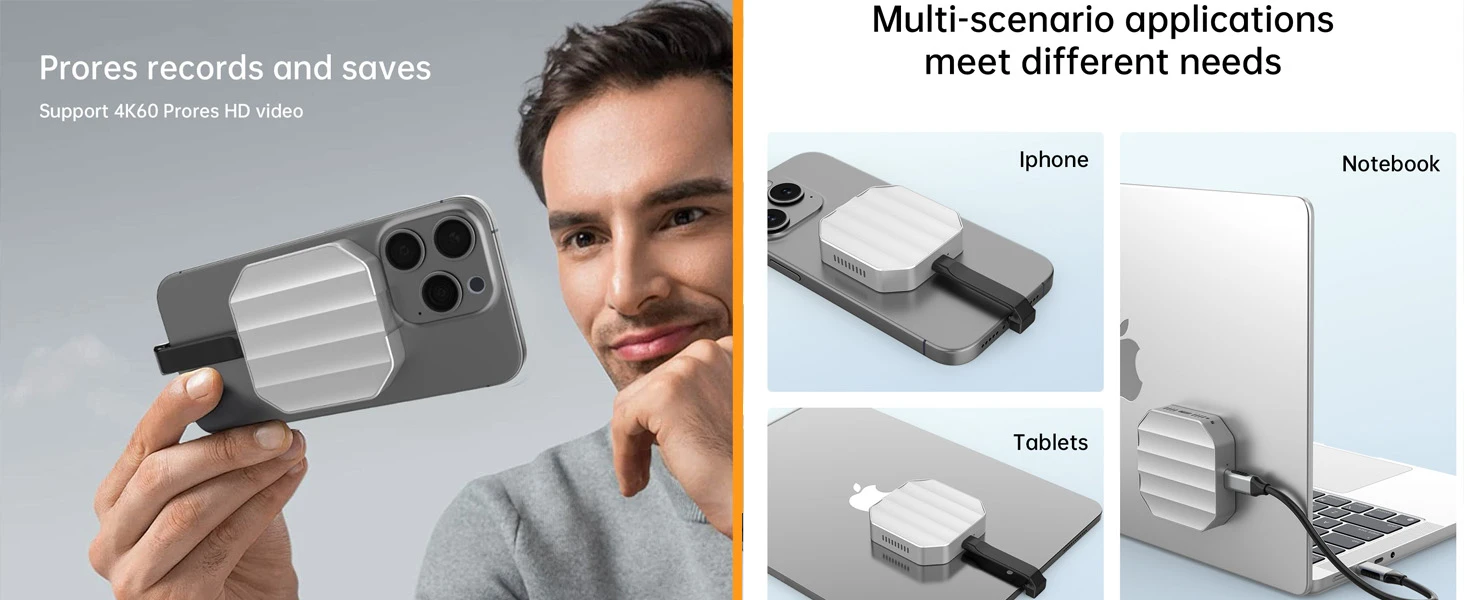
MSLFORCE Portable Magnetic SSD Enclosure- Redefining Mobile Storage for Professional Content Creators
The MSLFORCE Portable Magnetic SSD Enclosure features an innovative and proprietary design that sets it apart from conventional magnetic SSD enclosures on the market.While most competing products only support the smaller M.2 2230 SSD form factor due to limited internal space, MSLFORCE has successfully integrated support for both M.2 2230 and M.2 2242 SSDs within the same compact enclosure. This gives users greater flexibility in selecting storage capacities and SSD brands without sacrificing portability.
However, supporting larger SSDs is only part of the innovation.As smartphones such as the iPhone 15 Pro, iPhone 16 Pro, and future iPhone 17 Pro continue to push the boundaries of mobile content creation with Apple ProRes 4K recording, users frequently encounter two major challenges:
- Excessive heat generated during prolonged high-bitrate recording
- Rapid battery consumption while recording directly to external storage
In addition, a dedicated USB-C Power Delivery (PD) input port allows simultaneous charging and recording, ensuring your smartphone remains powered throughout long shooting sessions without compromising performance.
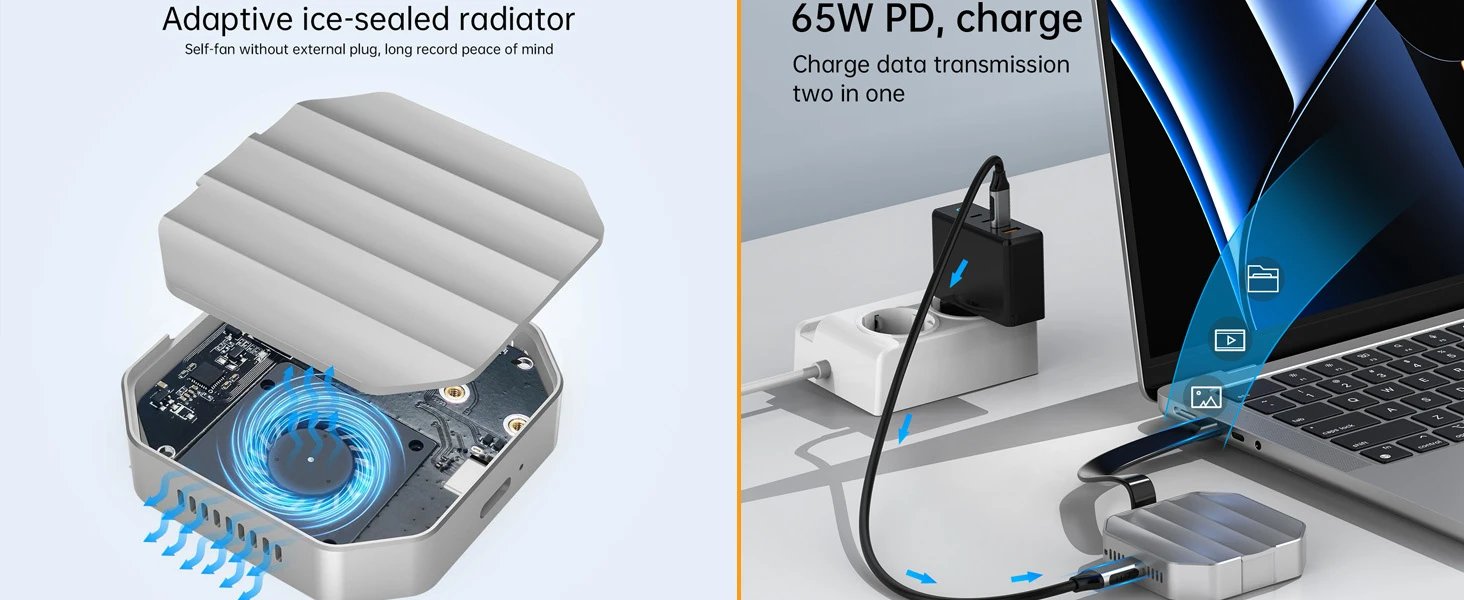 More Than an SSD Enclosure-A Complete Mobile Recording Solution
Every element of this product has been carefully engineered to enhance the user experience. The integration of larger SSD compatibility, active cooling, magnetic mounting, and PD charging is not just an industrial design breakthrough-it is a thoughtful solution created specifically for modern mobile filmmakers, photographers, vloggers, and content creators.
If your brand is searching for a premium magnetic external SSD storage solution for iPhone, Android devices, or professional mobile recording applications, MSLFORCE offers flexible OEM/ODM services to help you bring a differentiated product to market.
Designed for ProRes. Engineered for Reliability. Built for Creators.
MSLFORCE - Turning Mobile Devices into Professional Production Tools.
FAQ
Q: Can i attach this SSD Enclosure to an iPhone?
A: Boost your iPhone 17 Pro/Pro Max's capabilities. This Magnetic SSD Enclosure is widely compatible with the USB-C to iPhone 15, 16, and 17 Pro/Pro Max to continuously record in Apple ProRes 4K at 60fps.
Q: Are all SSDs size compatible with this Magnetic M.2 SSD Enclosure ?
A: Most magnetic SSD enclosures on the market only support the compact M.2 2230 SSD form factor due to space limitations. MSLFORCE took a different approach. Through innovative industrial and structural design, we successfully integrated support for both M.2 2230 and M.2 2242 SSDs into an ultra-compact magnetic enclosure, giving users greater flexibility when selecting storage capacity and SSD brands.
Q: Can your team assist in redesigning the appearance of this SSD enclosure?
A: Absolutely. Based on our existing and proven PCBA platform, MSLFORCE can develop a completely new OEM industrial design for this magnetic SSD enclosure, allowing your brand to create a unique product identity without the significant upfront investment typically required for developing a new product from scratch. By leveraging our existing hardware architecture, you can dramatically reduce development costs, tooling risks, and time-to-market while still obtaining an enclosure design that is exclusive to your brand. Our design team will work closely with you to understand your product portfolio, brand language, and target market. We can create an appearance that aligns with your existing product lineup, ensuring a consistent visual identity across your ecosystem of accessories and devices.
Q: What is your MOQ for redesigning the appearance of this SSD enclosure?
A: Thanks to our existing mass-production platform, we typically maintain inventory of the PCBA used in this SSD enclosure. By leveraging our proven hardware design and existing PCB dimensions, we can support very low MOQ requirements for customers who wish to create their own branded version. This approach significantly reduces development costs, minimizes project risk, and shortens the time required to launch your product.